

How to Treat Summer Sun Damage: Brown Spots, Redness and Texture

By the end of summer, many of our patients notice that brown spots look darker, redness is more visible, or their skin feels rougher and less even. One of the most common questions we hear is how to treat sun-damaged skin, and the answer depends on which of these changes you are seeing.
Sun damage is not one single concern. Brown pigmentation, visible blood vessels, uneven texture, and fine lines affect the skin differently, so each may call for a different treatment. Some patients may benefit from one targeted procedure, while others may need a combination.
In this guide, we’ll break down the treatments we may use for brown spots, redness, texture, and fine lines and explain how we decide what makes sense for your skin.
What does sun-damaged skin look like?
Cumulative ultraviolet exposure can affect the skin in several ways. Some changes can appear after one particularly sunny season, while others gradually become more noticeable over the years.
Visible signs of sun damage may include:
- Freckles and sun spots
- Uneven or blotchy pigmentation
- Persistent redness
- Visible facial blood vessels
- Dull or uneven skin tone
- Rough texture
- Fine lines
- Dry or dehydrated-looking skin
- Loss of firmness
You may notice more than one concern at the same time. For example, someone may have brown spots across the cheeks, redness around the nose, and rough texture throughout the face. Despite the fact that they all look different, they can all be traced back to sun damage.

Have new or changing spots evaluated first
Not every brown spot is cosmetic sun damage. Before treating any kind of pigmentation, we first want to understand exactly what we’re looking at.
A spot that is new, changing, irregular, bleeding, or not healing should be medically evaluated before any cosmetic treatment is considered. A cosmetic laser should never take the place of an appropriate skin examination.
At Simply Dermatology, we evaluate these concerns in a physician-led dermatology setting. If needed, we may use dermoscopy to take a closer look at the lesion. Once we confirm that the spot is benign, we can talk through whether a laser, light-based treatment, chemical peel, skincare, or another option is the best fit.
How to treat brown spots and uneven pigmentation
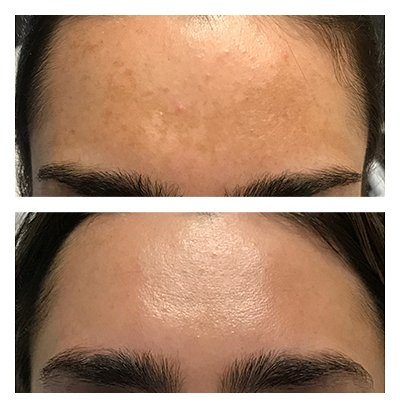
Brown spots form when excess pigment becomes concentrated in the skin. Pigmentation can appear in different patterns and at different depths, which influences the type of treatment that may be recommended.
Q-Switch laser for isolated brown spots
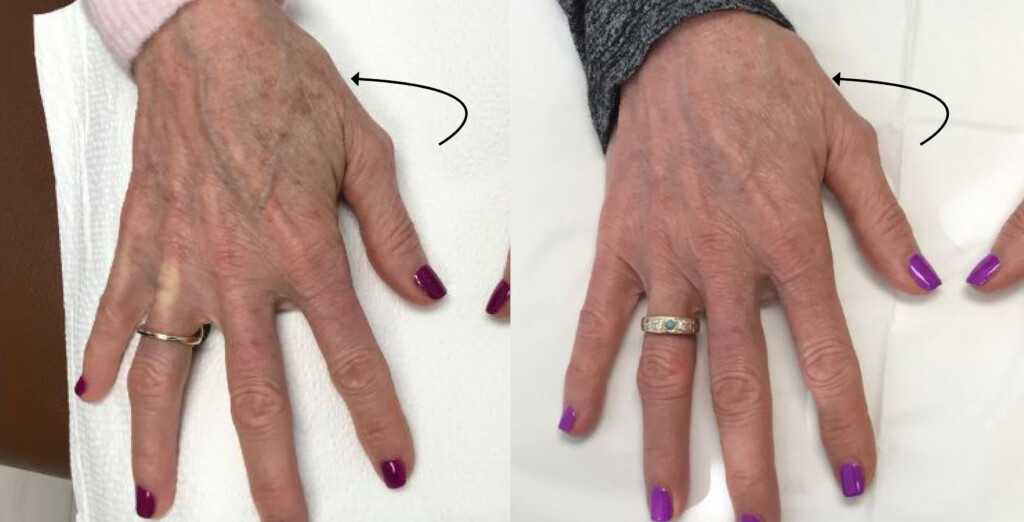
The Q-Switch laser may be used for select areas of unwanted pigmentation, including certain sun spots on the face, chest, or hands.
This laser delivers focused energy to the pigment in the treated area. After treatment, the spot may temporarily look darker before it begins to clear. The exact response and number of treatments needed vary based on the type and depth of the pigmentation. Typically, a series of treatments is recommended for best results.
IPL Photofacial for more widespread discoloration
Consider IPL Photofacial when pigmentation is spread across a larger area rather than limited to one spot. It can also be useful when brown discoloration appears alongside visible redness.
Although IPL is often discussed with cosmetic lasers, it uses intense pulsed light rather than one traditional laser wavelength. Skin tone, recent tanning, and the type of pigmentation all affect whether someone is an appropriate candidate.
Fraxel Laser for pigmentation and texture
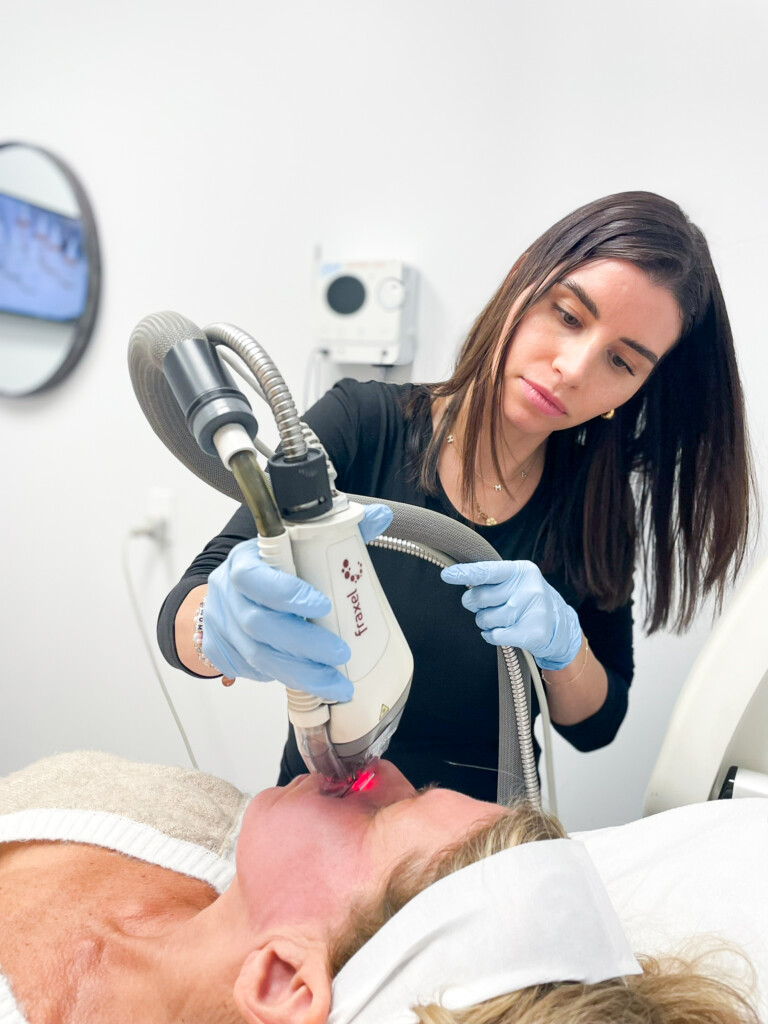
Fraxel may be a good option when pigmentation appears alongside rough texture, fine lines, or certain scars.
This laser uses two wavelengths, allowing the treatment to be adjusted according to the concern. One wavelength works closer to the skin’s surface and is often used for sun-related pigmentation and uneven tone. The other reaches more deeply and may be selected for texture, fine lines, and certain scars.
Fraxel is commonly performed as a series so improvement can build gradually. For a closer look at how it differs from deeper resurfacing, read our guide to Fraxel vs. CO2 laser treatments.
How to treat redness and visible blood vessels
Sun exposure can also make facial redness and visible blood vessels more noticeable. These vascular concerns respond to different technology than brown pigmentation.
VBeam for redness
VBeam is a vascular laser that may be used for persistent redness, visible facial blood vessels, and certain red marks left behind after acne. VBeam specifically targets vascular concerns rather than brown pigment.
IPL for mixed redness and pigmentation
IPL Photofacial may also be considered when redness is more diffuse or appears alongside brown pigmentation. For some patients, it provides a way to address multiple visible signs of sun exposure across the same area.
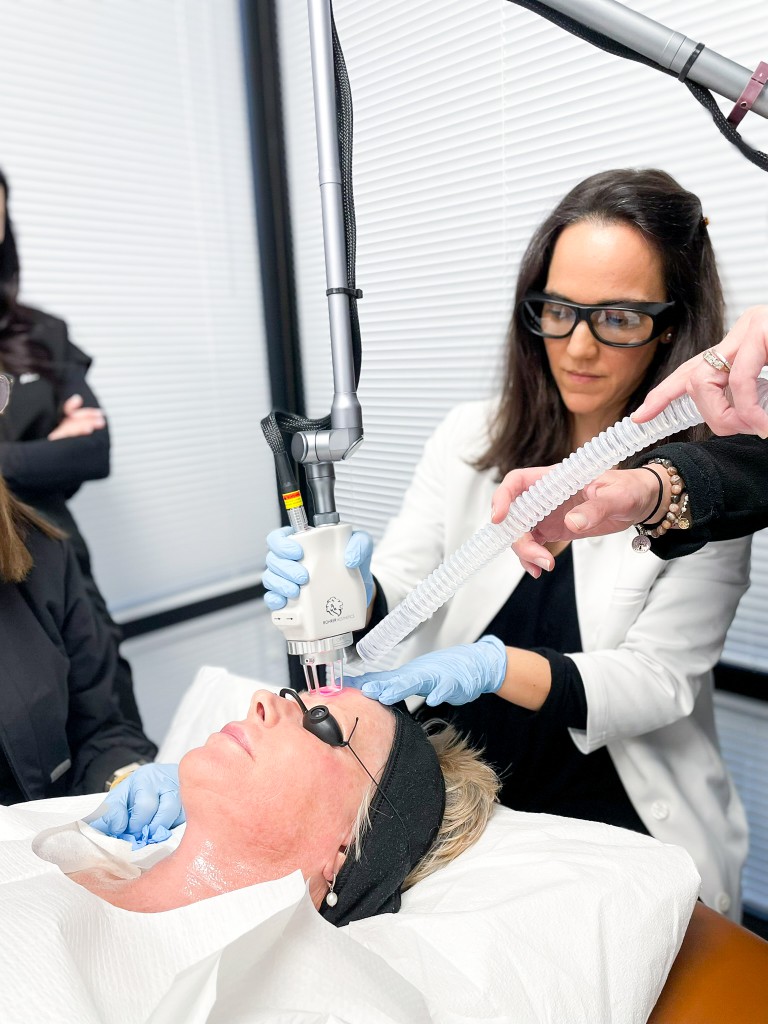
The choice between VBeam and IPL depends on what is creating the redness, how the discoloration is distributed, and the patient’s skin tone and treatment history.
How to improve rough texture, fine lines, and dullness
Sun damage does not only affect the color of the skin. Over time, UV exposure can contribute to rough texture, fine lines, and a less even-looking surface.
Clear + Brilliant for a gentle refresh
Clear + Brilliant is a gentle fractional laser that may be recommended for early sun damage, dullness, uneven tone, and mild texture changes. It’s sometimes referred to as a laser facial because it is so gentle.
It is often a good option for patients who want gradual skin refreshment with less downtime than more involved resurfacing treatments. A series is generally recommended for the best outcome.
Fraxel for more noticeable texture concerns
Fraxel provides more involved resurfacing than Clear + Brilliant. It may be used when uneven texture, fine lines, sun damage, or certain scars are more noticeable.
Recovery commonly includes redness, swelling, dryness, bronzing, and flaking. We generally advise patients to plan for approximately five to seven days of visible recovery, although healing varies based on the treatment settings and individual skin.
Fractional CO2 Laser for deeper resurfacing
CO2 laser may be considered when a patient has deeper wrinkles, more advanced texture changes, significant acne scarring, or more extensive accumulated damage.

Because CO2 provides deeper resurfacing, it also involves more preparation, recovery, and aftercare. Whether it is appropriate depends on the type and extent of the skin changes being treated, as well as the your skin and available recovery time.
Our Fraxel vs. CO2 comparison explains the differences in greater detail.
Can a chemical peel help with sun damage?
A chemical peel may help improve superficial discoloration, dullness, and uneven texture by encouraging the outer layers of the skin to shed and renew.
The type and strength of the peel should be selected according to your skin and goals. A peel may be performed on its own or incorporated into a longer treatment plan between other procedures.
Chemical peels work closer to the surface than treatments such as Fraxel or fractional CO2. The location and extent of the damage help determine whether a peel can address the concern or whether laser resurfacing may be more appropriate.
What if the pigmentation is melasma?
Melasma is different from an isolated sun spot. It often appears as larger, irregular patches of brown or gray-brown pigmentation, commonly on the cheeks, forehead, or upper lip.
Sun exposure can make melasma more noticeable, but heat, hormones, and inflammation may also contribute. Certain procedures can sometimes trigger or worsen the pigmentation.
For this reason, melasma requires a particularly cautious and individualized approach. Treatment may involve strict sun protection, carefully selected skincare, and procedures chosen specifically for your skin. A brown patch that looks like ordinary sun damage may not respond the same way as an isolated sun spot.
Can skincare improve sun-damaged skin?
Skincare can help brighten, hydrate, and support the skin while complementing professional treatments. What it can accomplish depends on the type and extent of the damage.
Daily broad-spectrum sunscreen is essential for preventing additional UV damage. It also helps protect the improvements achieved with lasers, light-based treatments, and chemical peels. Sunscreen remains important throughout fall and winter—not only during the summer.
An antioxidant serum such as Simply Serum® CE + Ferulic can provide additional daytime support, while hydrating products help maintain the skin barrier. The right routine depends on your skin and the treatment you are preparing for or recovering from.
Certain active ingredients may need to be paused before or after a procedure. Follow the instructions provided by your treating provider rather than assuming your usual routine should continue unchanged.

Why a combination of treatments may be recommended
Brown spots, redness, rough texture, fine lines, and skin laxity involve different structures within the skin. When several concerns are present, a treatment plan may address them in stages.
An example treatment plan might be Q-Switch treatment for isolated brown spots and VBeam for visible facial vessels. Or maybe a series of Fraxel treatments only for pigmentation and texture. If skin laxity is also present, a collagen-stimulating treatment such as Ultherapy Prime or Micro RF may be planned separately.
This is part of our layered approach at Simply Dermatology. We look at each concern individually and determine how treatments can be combined or spaced over time to create balanced, natural-looking improvement.
You can explore more of our complexion treatments for pigmentation, redness, texture, and acne scarring.
How we create a treatment plan for sun-damaged skin
When deciding how to treat sun-damaged skin, the Simply Dermatology team considers:
- The type of discoloration or texture change
- The depth and extent of the concern
- Skin tone and pigmentation history
- History of melasma
- Skin sensitivity
- Recent tanning or sun exposure
- Medical history and current medications
- Previous treatments
- Current skincare routine
- Desired improvement
- Available recovery time
- Upcoming travel or special events
This physician-led evaluation helps us determine which concerns can be addressed together and which may need separate treatments.
When should you begin treatment?
Fall is a convenient time for many patients to begin correcting visible summer damage. Reduced sun exposure can make it easier to protect the skin before and after treatment, particularly when a procedure causes temporary redness, dryness, peeling, or sensitivity.
Some treatments require a series, while collagen remodeling continues for weeks or months after others. If you are preparing for the holidays, a wedding, or another important event, it helps to begin the conversation early.
Laser treatments can still be performed during other seasons when appropriate. Our guide to laser treatments in the fall explains why cooler months are often a practical time to start.
Treating the visible signs of summer sun damage
Summer sun damage may appear as brown spots, persistent redness, rough texture, fine lines, or a combination of concerns. Treating it effectively starts with understanding which changes are present and which treatments are designed to address them.
At Simply Dermatology, our team evaluates your skin as a whole and may recommend laser treatments, light-based treatments, chemical peels, skincare, or a layered combination based on your individual needs.
To schedule a cosmetic consultation at our Melville office, call 631-377-7241.
-Dr. Papantoniou
Other blogs you might like to check out: how to treat summer acne and how a Salt Facial can help with summer skin concerns