

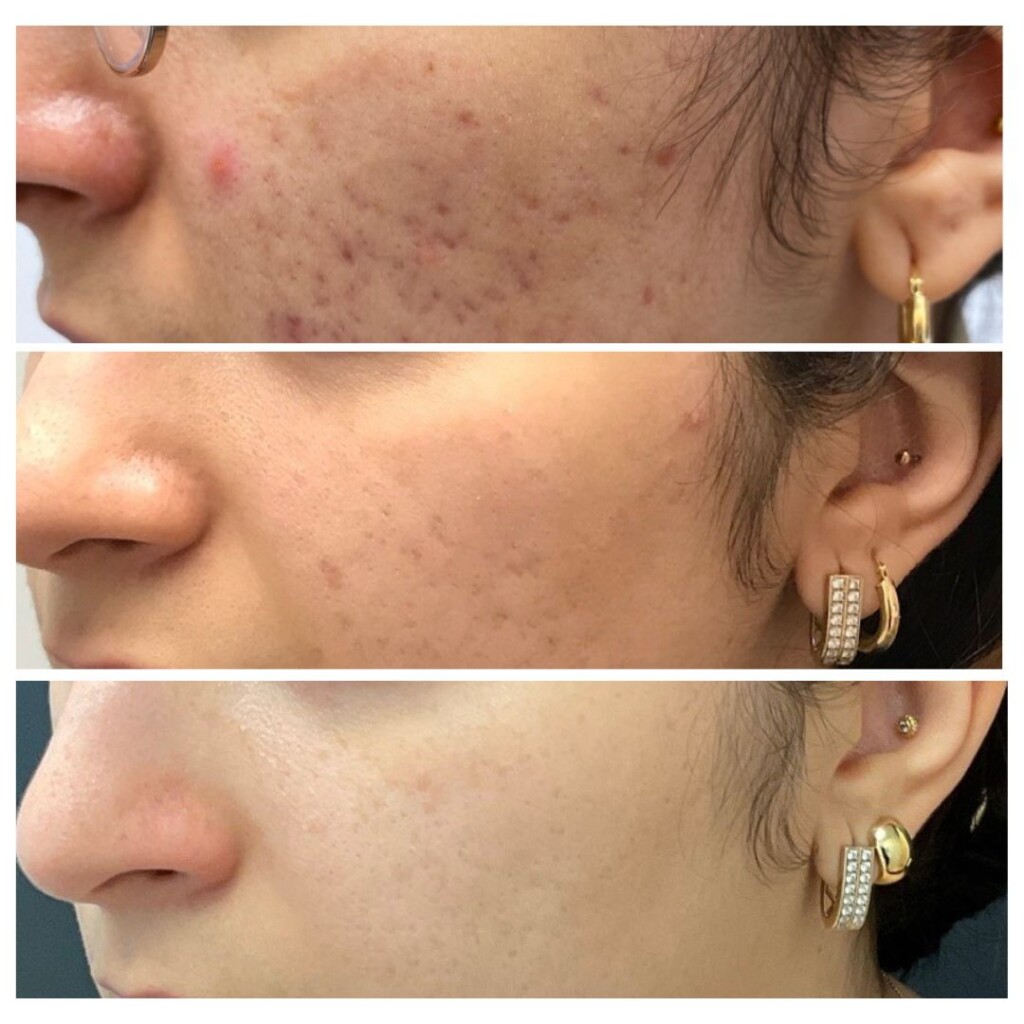
Improving Acne Scars
Every day I treat people for acne and acne scarring. Luckily, there are very effective treatment options available to improve the appearance of acne scars. There are also some treatment myths that need to be cleared up. We begin by looking at the type of scarring, your skin tone, and whether acne is still active. Those details help us build a realistic plan. Here are seven things to understand before choosing a treatment.
1. Get Active Acne Under Control
The first thing I always address with my patients is whether they are still breaking out, if you are still getting acne lesions, you first need to get control of the acne. Otherwise, new scars will be developing, and money and effort will be wasted to treat scars without doing anything to prevent new scars. I make a point to make this clear to my patients, because I believe it is important in order for the outcome to be the best possible.
2. Laser Treatments for Acne Scars
The top 3 treatments I believe work the best for acne scarring are Fraxel (a fractionated resurfacing laser), Pixel (which is a CO2 laser), and microneedling. The best choice depends on the scar pattern, skin tone, and recovery time that works for you.
Fraxel laser will take 3-5 treatments, but has a relatively quick recovery; it creates microscopic treatment zones in the skin with spared healthy skin in between these areas, so the skin heals quickly. Patients will have redness after a treatment, similar to a sunburn, but this usually resolves over 3-7 days, and makeup may be worn. The CO2 laser, which is often used together with an Erbium YAG laser, is similar to Fraxel but is a much more intense laser, with most patients only needing 1-2 treatments. This laser treatment does require a recovery period of 7-10 days, with frequent application of ointments to the face until completely healed. Microneedling is really gaining popularity for acne scarring. Professional microneedling uses fine needles to encourage collagen remodeling. It may help select indented scars, with treatment and recovery tailored to your skin. Different scar patterns may benefit from a combination of approaches.
3. Skincare That Can Actually Help
A lot of people ask me what kind of creams should they purchase. The ingredient that is most helpful in the treatment of mild scarring is retinoic acid or retinol. Retinoic acid comes in many different formulations from the generic tretinoin, to well-known brands such as Retin A, Renova, Tazorac or Atralin. Retinoic acid/Retinol containing creams can help stimulate new collagen production. Used in a pea size amount in the evening, these creams are usually very tolerable. It is a useful medication to treat the acne and acne scarring together.
4. Derma Rollers and Microneedling for Acne Scars
Microneedling can help improve the appearance of some acne scars by encouraging collagen production. But what about using a derma roller at home? A derma roller is a handheld tool with a rotating head covered in small needles used to roll over the surface of scars to create small perforations similar to those made by lasers. These small injuries to the skin heal with new collagen in the areas treated.
Home devices do not provide the same treatment as professional microneedling. Needles that penetrate the skin, excessive pressure, or frequent use can cause irritation, infection, additional scarring or changes in pigmentation.
Before trying a derma roller for acne scars, check with a board-certified dermatologist. Your scar type, skin tone, and any active breakouts help determine whether microneedling is appropriate. Professional treatment also requires careful technique and aftercare. Results develop gradually, and a series of treatments is usually recommended.
5. Chemical Peels vs Laser Treatments
Chemical peels were historically among the first treatments available for scar treatments, but now, with advances in technology, I generally don’t recommend them in my practice for the treatment of scarring. The reason for this is that in order for a chemical peel to be useful in the appearance of deep acne scarring, the peel has to be very strong. A strong peel, such as would be necessary for deep acne scarring should only be used in a very fair skin type, otherwise this can be very risky for skin discoloration and scarring. Because of their limitations of use for different skin types, it becomes prohibitive for other patients. It can take many peels in order to see results, meanwhile only several laser treatments would have been necessary to achieve better results in a shorter timeframe. That being said, I do use chemical peels routinely with great results: for discoloration/hyperpigmentation and dull complexions.
6. Time
Time! Time has a role in the treatment of scars, a new scar will often have a red appearance to it. And this can take time to improve. There is a delayed healing process that occurs after a scar treatment has been administered. It can take 3 to 6 months to see the full effect of a treatment, this is because there is a slow tissue remodeling process which occurs with new collagen and elastin being produced in the areas treated. This is why good photographs are so important! Often patients even forget how their skin looked prior to starting their treatments, and are very encouraged when they see how much they have improved.
7. Fillers and Collagen
Filling pitted acne scars with fillers. Injectables, such as Restylane (a hyaluronic acid-based filler) or Bellafill (previously called Artefill, a collagen-based filler) can be used to fill select pitted and boxcar acne scars. The advantage is that the results are quick, without the long wait for tissue remodeling. The drawback is that some fillers are not permanent and will not address the textural component of the scarring or skin tone.
Improving Acne Scars at Simply Dermatology
If you are interested in what would work best for your skin see your Dermatologist for the best fit for your needs. Scarring does not need to be newer in order to be amenable to treatment, the oldest of scars can still be improved!

Dr. Kally Papantoniou, MD, FAAD
Board Certified Dermatologist: Cosmetic & Medical
Simply Dermatology
Mount Sinai Dermatology Clinical Instructor